IUCN SSC Shark Specialist Group
  • Home
  • About
    • Mission & Vision
    • Diversity, Equity, Inclusion
    • Sponsors
    • Visual Identity and Brand Guide
    • Annual Reports
    • Membership | TOR
    • FAQ
  • Members
    • Who We Are >
      • Our Team
      • Our Members
      • Our History
    • Where We Work >
      • North America
      • Central America and the Caribbean
      • South America
      • Northern Europe
      • Mediterranean
      • Africa
      • Indian Ocean
      • ​Asia
      • Oceania
    • What We Do >
      • Aquarium Working Group
      • Assess Working Group
      • Bycatch Working Group
      • Communication Working Group
      • Deepwater Chondrichthyans Working Group
      • Human Dimensions Working Group
      • Integrative Taxonomy Working Group
      • Marine Historical Ecology Working Group
  • Resources
    • Shark News >
      • Shark News | Submission Guidelines
    • Shark News Legacy
    • Important Shark and Ray Areas >
      • ISRA Scientific Publications
    • Publications >
      • 2024 Global Status Report
      • Status Reports
      • Fisheries Management
      • Conservation Strategies
      • Migratory Species
      • Process Maps
      • SSG Statements
      • Identification Guide
      • Trade
      • Other
    • Policy Planning >
      • CITES >
        • CITES 17th CoP
      • The Convention on Migratory Species and Sharks
      • The Memorandum of Understanding on the Conservation of Migratory Sharks (Sharks MOU)
      • The IUCN Red List of Threatened Species and Sharks
      • RFMOs
      • IPOA-Sharks
    • Workshops
    • Press
    • Links
    • Media Resources
    • Scientific References
  • News
  • Contact
  • Donate

News

A New Hope

20/9/2022

 
A newly released peer-reviewed paper in Frontiers in Marine Science emphasises that establishing measures to address the global decline in Chondrichthyes is more urgent than ever.
Picture
© Important Shark and Ray Areas
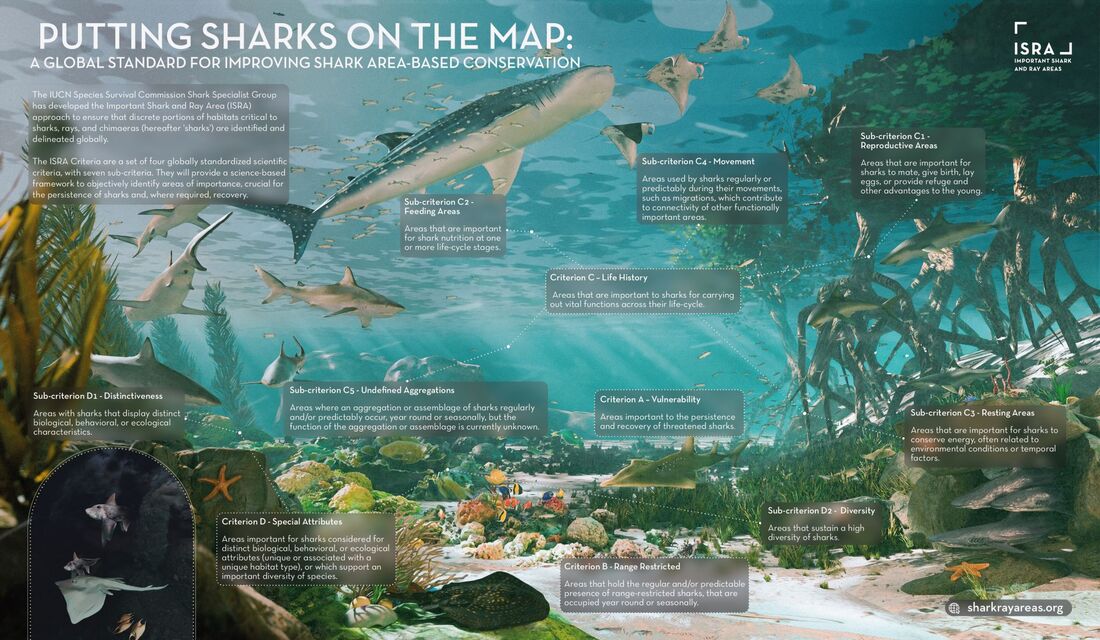
​The paper, “Putting sharks on the map: a global standard for improving shark area-based conservation,” outlines a set of standardized criteria for Important Shark and Ray Areas (ISRAs) that can support management considerations to reverse the loss of sharks globally and integrate these into area-based planning.
From | SOSF Project News
Written by | Lynn Sorrentino, Ciaran Hyde, Rima Jabado


«A newly released peer-reviewed paper in Frontiers in Marine Science emphasises that establishing measures to address the global decline in Chondrichthyes (sharks, rays, and chimaeras [ghost sharks], hereafter ‘sharks’) is more urgent than ever. The paper, “Putting sharks on the map: a global standard for improving shark area-based conservation,” outlines a set of standardized criteria for Important Shark and Ray Areas (ISRAs) that can support management considerations to reverse the loss of sharks globally and integrate these into area-based planning.
 
Why do sharks need protection?
The most recent global IUCN Red List of Threatened Species (IUCN Red List) assessment of sharks estimated that over one-third of species (37%, range 32.6–45.5%) are threatened with extinction (i.e., considered Critically Endangered, Endangered, or Vulnerable). Three-quarters of oceanic species are threatened with extinction, and all but one of the 16 species of wedgefishes and giant guitarfishes face a very high risk of extinction.
​
Current measures for the protection and improvement of shark habitats are not working. Yet area-based protection is a cornerstone for halting the loss of biodiversity, and the number of initiatives focused on identifying key sites or seascapes of importance for biodiversity conservation has proliferated in recent decades. The IUCN SSC Shark Specialist Group, with support from the IUCN Ocean Team and the IUCN Task Force on Marine Mammal Protected Areas, have developed ISRAs: an innovative approach to ensure that discrete portions of habitats critical to shark species are delineated and used in various place-based conservation and management initiatives across the world’s ocean.»
View Online
Picture
© Important Shark and Ray Areas

Comments are closed.

    Archives

    All
    2014
    2018
    2020
    2021
    2022
    2023
    2024
    2025
    2026


Picture
Picture
Picture
Picture
Picture
Picture
Picture
Picture
Picture
Copyright © 2026 | IUCN SSC Shark Specialist Group | All Rights Reserved
  • Home
  • About
    • Mission & Vision
    • Diversity, Equity, Inclusion
    • Sponsors
    • Visual Identity and Brand Guide
    • Annual Reports
    • Membership | TOR
    • FAQ
  • Members
    • Who We Are >
      • Our Team
      • Our Members
      • Our History
    • Where We Work >
      • North America
      • Central America and the Caribbean
      • South America
      • Northern Europe
      • Mediterranean
      • Africa
      • Indian Ocean
      • ​Asia
      • Oceania
    • What We Do >
      • Aquarium Working Group
      • Assess Working Group
      • Bycatch Working Group
      • Communication Working Group
      • Deepwater Chondrichthyans Working Group
      • Human Dimensions Working Group
      • Integrative Taxonomy Working Group
      • Marine Historical Ecology Working Group
  • Resources
    • Shark News >
      • Shark News | Submission Guidelines
    • Shark News Legacy
    • Important Shark and Ray Areas >
      • ISRA Scientific Publications
    • Publications >
      • 2024 Global Status Report
      • Status Reports
      • Fisheries Management
      • Conservation Strategies
      • Migratory Species
      • Process Maps
      • SSG Statements
      • Identification Guide
      • Trade
      • Other
    • Policy Planning >
      • CITES >
        • CITES 17th CoP
      • The Convention on Migratory Species and Sharks
      • The Memorandum of Understanding on the Conservation of Migratory Sharks (Sharks MOU)
      • The IUCN Red List of Threatened Species and Sharks
      • RFMOs
      • IPOA-Sharks
    • Workshops
    • Press
    • Links
    • Media Resources
    • Scientific References
  • News
  • Contact
  • Donate